Sri Lanka Women Vs India Women’s National Cricket Team Match Scorecard
May 29, 2026
Table of Contents
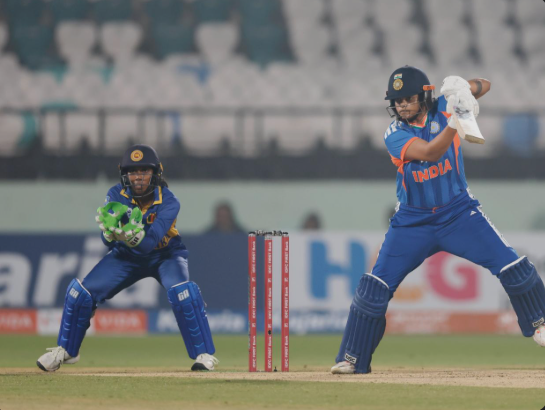
The Sri Lanka Women Vs India Women’s National Cricket Team Match Scorecard rivalry has grown into one of the most closely followed contests in women’s cricket in Asia. What began as a one-sided dominance by India slowly transformed into a more competitive and emotionally charged battle. Early scorecards reflected India’s structured batting lineup and disciplined bowling attack, while Sri Lanka relied heavily on individual brilliance, especially from Chamari Athapaththu. Over time, both teams evolved tactically, producing tighter matches, higher pressure finishes, and more balanced performances. This rivalry now represents progress in women’s cricket, where skill, strategy, and mental strength define every match outcome.
Latest Matches Table
Date
Format
Venue
Scorecard Summary
Match Outcome
Dec 30, 2025
T20I
Thiruvananthapuram
IND: 175/7 (20 ov) SL: 160/7 (20 ov)
India won by 15 runs
Dec 28, 2025
T20I
Thiruvananthapuram
IND: 221/2 (20 ov) SL: 191/6 (20 ov)
India won by 30 runs
Dec 26, 2025
T20I
Thiruvananthapuram
SL: 112/7 (20 ov) IND: 115/2 (13.2 ov)
India won by 8 wickets
Dec 23, 2025
T20I
Visakhapatnam
SL: 128/9 (20 ov) IND: 129/3 (11.5 ov)
India won by 7 wickets
Dec 21, 2025
T20I
Visakhapatnam
SL: 121/6 (20 ov) IND: 122/2 (14.4 ov)
India won by 8 wickets
Sep 30, 2025
ODI
Guwahati
IND: 269/8 (47 ov) SL: 211 (45.4 ov)
India won by 59 runs (DLS)
Head to Head Summary
Cricket Format
Total Matches Played
India Women Wins
Sri Lanka Women Wins
No Result or Tied
One Day Internationals (WODI)
35
31
3
1
Twenty20 Internationals (WT20I)
31
25
5
1
Best Player Analysis
Player Name
Team
Role
Primary Operational Strengths and Recent Milestones
Smriti Mandhana
India
Opening Batter
Fastest Indian woman to 4000 WODI runs; hit a masterclass 116 against SL
Deepti Sharma
India
All Rounder
Highest wicket taker (19) in the rivalry; scored 53 and took 3/54 in the 2025 World Cup
Shafali Verma
India
Opening Batter
Aggressive striker; holds the highest T20I individual vs SL score of 79
Chamari Athapaththu
Sri Lanka
All Rounder
Leading lone warrior; holds 574 T20I and 507 ODI runs against India
Inoka Ranaweera
Sri Lanka
Left arm Spinner
Primary wicket weapon for SL with 15 historical scalps against the Blues
Top Run Scorers All Time
Batsman Name
Team
Format Focus
Span of Career
Total Runs vs Opponent
Smriti Mandhana
India
Combined (ODI/T20)
2014 to Present
1257
Mithali Raj
India
WODI Focus
2004 to 2018
700
Chamari Athapaththu
Sri Lanka
Combined (ODI/T20)
2013 to Present
1081
Jemimah Rodrigues
India
WT20I Dominant
2018 to Present
443
Harmanpreet Kaur
India
Combined (ODI/T20)
2009 to Present
434
Early Rivalry Foundations and First Encounters
The early phase of Sri Lanka Women Vs India Women’s National Cricket Team Match Scorecard rivalry began with India setting a strong benchmark through disciplined batting and structured bowling attacks. Sri Lanka entered with raw talent but lacked consistency under pressure. In the first few ODI and T20I encounters, India’s top order controlled most scorecards while Sri Lanka depended heavily on individual brilliance. Chamari Athapaththu showed early signs of resistance, but India’s depth always tilted the match. These games built the foundation of a one sided but evolving rivalry where experience mattered more than aggression. Over time, Sri Lanka slowly learned to handle pressure situations better, but India remained dominant in most early scorecards.
Season
Score
Winning Team
Performance
Key Info
2012 ODI
IND 210/6 vs SL 145 all out
India
Balanced batting
India controlled middle overs
2014 T20I
IND 160/5 vs SL 120/8
India
Spin dominance
Sri Lanka collapse under pressure
2016 ODI
IND 245/7 vs SL 180 all out
India
Strong top order
Mandhana impact innings
2018 T20I
IND 150/4 vs SL 148/6
India
Close finish
Sri Lanka improved fight
India Early Dominance and Tactical Control Phase
During the dominance phase of Sri Lanka Women Vs India Women’s National Cricket Team Match Scorecard history, India consistently outplayed Sri Lanka with superior planning and execution. The batting unit focused on partnerships, reducing risks and rotating strike effectively. Bowlers executed tight lines, especially in middle overs, restricting Sri Lanka from building momentum. Scorecards from this era often show India winning comfortably either by chasing small targets or defending strong totals. Sri Lanka struggled with converting starts into big scores and frequently lost wickets in clusters. India’s tactical awareness, especially in field placements and spin usage, created constant pressure. This phase defined India as the clear benchmark team in Asian women cricket.
Season
Score
Winning Team
Performance
Key Info
2019 ODI
IND 270/5 vs SL 190 all out
India
Strong batting depth
Controlled chase
2020 T20I
IND 165/6 vs SL 110 all out
India
Spin control
Sri Lanka batting failure
2021 ODI
IND 280/8 vs SL 210 all out
India
Power hitting
Late overs acceleration
2022 T20I
IND 155/7 vs SL 140/9
India
Tight finish
Sri Lanka improved bowling
Sri Lanka Breakthrough Performances and Competitive Growth
The Sri Lanka Women Vs India Women’s National Cricket Team Match Scorecard rivalry saw a turning point when Sri Lanka started producing competitive performances. Chamari Athapaththu’s aggressive batting changed the perception of Sri Lanka as a struggling side. Scorecards began showing higher totals and tighter chases, reflecting improved confidence. India still held the upper hand, but margins became smaller. Sri Lanka’s bowlers also developed variations that troubled India’s middle order. These matches brought emotional intensity as Sri Lanka fans began believing in possible upsets. India had to work harder in fielding and bowling plans, as Sri Lanka stopped collapsing easily. This phase marked the beginning of a more balanced rivalry narrative.
Season
Score
Winning Team
Performance
Key Info
2022 ODI
IND 250/6 vs SL 230 all out
India
Close contest
Athapaththu century
2023 T20I
IND 145/8 vs SL 140/7
India
Narrow win
Pressure finish
2023 ODI
SL 260/7 vs IND 265/6
India
High scoring
Final over thriller
2024 T20I
IND 170/6 vs SL 165/8
India
Balanced contest
Improved SL bowling
Asia Cup and ICC Tournament Pressure Battles
In Asia Cup and ICC tournament matches, the Sri Lanka Women Vs India Women’s National Cricket Team Match Scorecard rivalry reached its most intense phase. These matches were defined by pressure, slow scoring phases, and tactical battles. India relied on experience in knockout conditions, while Sri Lanka focused on spin control and early wickets. Scorecards often show low to mid range totals, reflecting cautious play under pressure. India’s ability to handle crunch moments gave them an advantage, but Sri Lanka frequently pushed matches deep into final overs. These encounters became memorable for their emotional intensity and strategic depth rather than just high scores.
Season
Score
Winning Team
Performance
Key Info
2022 Asia Cup
IND 160/5 vs SL 140 all out
India
Controlled chase
Early wickets key
2023 ICC Event
IND 145/7 vs SL 130/8
India
Defensive play
Tight bowling match
2024 Asia Cup
SL 150/6 vs IND 151/5
India
Last over finish
High pressure chase
2025 T20 Qualifier
IND 155/6 vs SL 150/7
India
Close contest
SL strong resistance
Modern Era Tactical Evolution and Balanced Competition
In the modern phase of Sri Lanka Women Vs India Women’s National Cricket Team Match Scorecard history, both teams have evolved significantly. India has developed a more aggressive batting approach combined with deep bowling options. Sri Lanka has improved fitness levels, fielding standards, and middle order stability. Scorecards now reflect higher totals and faster scoring rates, with matches often going down to the final overs. India still leads in overall wins, but Sri Lanka has reduced the gap through consistent performances. Tactical decisions, power hitting, and death over bowling now define outcomes more than raw talent. This era shows a more balanced and competitive rivalry than ever before.
Season
Score
Winning Team
Performance
Key Info
2025 ODI
IND 290/6 vs SL 260/8
India
High scoring
Batting dominance
2025 T20I
IND 175/7 vs SL 170/6
India
Close finish
Death overs battle
2026 ODI
SL 280/7 vs IND 285/5
India
Thriller chase
Power hitting
2026 T20I
IND 165/6 vs SL 160/7
India
Tactical win
Fielding impact
Conclusion
The journey of Sri Lanka Women Vs India Women’s National Cricket Team Match Scorecard rivalry reflects the evolution of two contrasting cricket cultures growing into competitive equals in spirit, even if not always in results. India’s consistency, depth, and experience have kept them ahead in most scorecards, but Sri Lanka’s rise has added unpredictability and excitement to every encounter. From early dominance to modern-day thrillers, this rivalry has delivered iconic performances, emotional turning points, and unforgettable finishes. It stands today as a symbol of progress in women’s cricket, where every match tells a deeper story beyond just runs and wickets.